
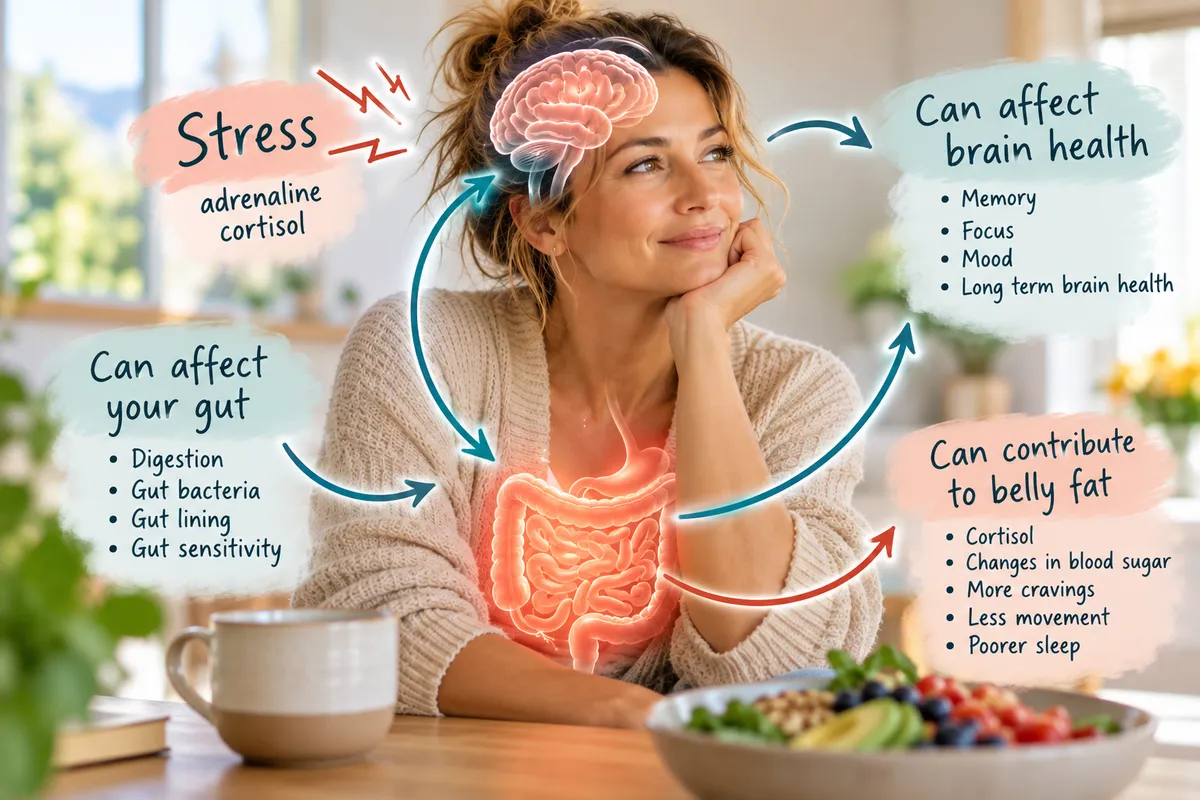
Is Your Stress Affecting Your Gut, Your Weight and Your Brain?
We often talk about stress as if it only happens in our heads.
But your body doesn't see it that way.
If you are constantly rushing, worrying, juggling work and family, sleeping badly or simply feeling that you never quite switch off, your brain receives the message that something needs dealing with.
And your gut is listening.
Your gut and brain are constantly talking
Your gut and brain communicate all day through what scientists call the gut brain axis. Think of it as a two way conversation involving your nervous system, hormones, immune system and the trillions of microorganisms living in your gut. (1)
This is particularly relevant to IBS. IBS is now recognised as a disorder of gut brain interaction, which is a rather complicated way of saying that what happens in your brain can affect your gut, and what happens in your gut can affect your brain. (2)
So when somebody tells you that stress is affecting your IBS, they are not saying your symptoms are imaginary.
Quite the opposite. There are genuine physical mechanisms connecting the two.
What actually happens when you're stressed?
Imagine you are about to give an important presentation. Your brain senses a threat and your stress response kicks in.
Adrenaline rises quickly. Your heart beats faster and your body prepares you to react. Then cortisol, one of our main stress hormones, gets involved.
In the short term this is brilliant. We need adrenaline and cortisol. They help us respond to danger and cope with demanding situations.
The problem comes when the alarm never seems to switch off.
Research suggests that ongoing stress can change how quickly food moves through your digestive system, make your gut more sensitive and affect your gut bacteria, immune system and the protective barrier lining your gut. (3)
One human study even found that acute psychological stress increased the permeability of the bowel lining, sometimes referred to as "leaky gut". (4) More research is needed, but this is why I encourage my clients to notice not just what they are eating, but how they are feeling.
Do your reflux symptoms get worse when you're stressed? Do you feel more bloated, more sensitive to certain foods, or notice that your IBS suddenly flares up?
Stress may not be the whole explanation, but it is definitely something worth considering. Sometimes the answer isn't simply about removing another food from your diet. It may also be about understanding what else is going on in your life and helping your nervous system calm down.
And what about that stubborn belly fat?
This is another interesting part of the stress story.
Research involving more than 1,800 adults found that people experiencing greater long-term stress tended to carry more fat around their middle, including more visceral fat, the deeper fat stored around our organs. (5)
Cortisol may be part of the reason.
When we're under pressure, our body wants energy available in case we need to deal with a threat. Cortisol helps make more glucose, or sugar, available in the blood.
Useful if you need to run away from a lion. Less useful if the "lion" is your overflowing inbox.
And then there's the human bit.
When you're exhausted and stressed, you're probably less interested in cooking salmon and broccoli and considerably more interested in something involving chocolate.
Poor sleep, comfort eating, less movement and alcohol can all join the party.
So stress doesn't magically create belly fat. But long-term stress can create an environment that makes maintaining a healthy weight considerably harder. (5)
Your brain isn't escaping either
This is something Datis Kharrazian discusses in Why Isn't My Brain Working? He describes how prolonged stress can affect the brain, particularly the hippocampus, the part that plays an important role in learning and memory. (6)
Modern research continues to investigate this connection.
In people already experiencing mild memory lapses, higher levels of the stress hormone cortisol have been linked with changes in the hippocampus, the part of the brain that helps us learn and remember things. (7)
In simple terms, too much stress for too long may make it harder for our brain to work as well as it should.
This doesn't mean stress causes Alzheimer's disease, and I certainly don't want you worrying about your cortisol because you've forgotten where you put your keys!
But it is another good reason to take long-term stress seriously.
This is why I don't just talk about food
When I work with somebody with IBS, reflux or weight issues, I'm interested in what they eat.
Of course I am. I'm a nutritional therapist.
But I also want to know how they eat, how they sleep, how stressed they are, whether they ever stop rushing and whether their nervous system gets an opportunity to calm down.
Because you can have the most beautiful diet in the world, but if you're eating it standing in the kitchen while answering emails and worrying about tomorrow, we may be missing an important part of the picture.
Good gut health isn't about perfection.
Sometimes the first step is simply giving your body fewer reasons to believe it is under attack.
References
1. Mayer EA, Nance K, Chen S. The Gut Brain Axis. Annual Review of Medicine. 2022;73:439–453.
2. Stengel A, et al. Emotional stress responsivity of patients with IBS, a systematic review. Journal of Psychosomatic Research. 2022;153:110694.
3. Leigh SJ, et al. The impact of acute and chronic stress on gastrointestinal physiology and function: a microbiota gut brain axis perspective. The Journal of Physiology. 2023;601(20):4491–4538.
4. Vanuytsel T, et al. Research into psychological stress and intestinal permeability in humans, discussed in: Psychosocial stress induced intestinal permeability in healthy humans: What is the evidence? 2023.
5. Kershaw KN, et al. Chronic Stress Burden, Visceral Adipose Tissue, and Adiposity Related Inflammation: The Multi Ethnic Study of Atherosclerosis. Psychosomatic Medicine. 2021.
6. Kharrazian D. Why Isn't My Brain Working? Chapter 6, Stress and the Brain. Elephant Press.
7. White S, et al. The effect of plasma cortisol on hippocampal atrophy and clinical progression in mild cognitive impairment. Alzheimer's & Dementia: Diagnosis, Assessment & Disease Monitoring. 2023;15.